TL;DR: The Great Migration is a year-round loop of more than a million wildebeest, with zebras and gazelles, through Tanzania's Serengeti and Kenya's Masai Mara. From December to March the herds calve in the southern Serengeti. From April to June they head west and north, and the rut begins. From July to October they reach the northern Serengeti and the Mara River. Pick your month by what you want to see, and we'll plan the route.
Every year, more than a million wildebeest walk a giant loop through the Serengeti, and they never stop. That's why a Great Migration month by month plan matters. The right month and area put you in the middle of the herds. The wrong ones can leave you with quiet, empty plains.
The herds follow the rain and fresh grass across Tanzania's Serengeti National Park and into Kenya's Masai Mara. Calving, the rut and the river crossings each happen in a different place and season.
This guide shows a calendar at a glance, where the herds usually are each month, the best time for each highlight and how to plan your safari around it. One honest note first: the migration runs on rain, not on a calendar, so the dates can shift by a few weeks.
What Is the Great Migration?
The Great Migration is the yearly journey of more than a million wildebeest, together with hundreds of thousands of zebras and gazelles, through Tanzania's Serengeti and Kenya's Masai Mara. The herds walk a loop of roughly 1,900 km a year, following the rains to fresh grass and water.
The latest official count, the 2023 wildebeest census by TAWIRI, found about 1.37 million wildebeest in March 2023. TAWIRI, the Tanzania Wildlife Research Institute, counts the herds from the air. Lonely Planet's guide to the migration adds about 250,000 zebras to the picture.
Why do they move? Rain. Grass grows where the rain falls, and the herds go where the grass is. Our guide to Tanzania's rain month by month shows when each part of the country gets wet.
The Serengeti has been a UNESCO World Heritage Site since 1981, partly because of this migration. And because the rains change every year, no two migrations are the same. Lonely Planet also stresses that the herds don't follow a strict schedule.
Great Migration Calendar at a Glance
Here's where the herds usually are in each month, what's happening and which part of the Serengeti to stay in.
Typical pattern, based on Wanderlust's Great Migration calendar. The herds can be a few weeks early or late.
Where Is the Great Migration From November to March?
From November to March, the Great Migration is mostly in the southern Serengeti. The herds walk south with the short rains in November, spread across the green plains around Ndutu by December, and give birth there in late January and February. In March they start to gather for the journey north.
November
In November the short rains begin, and the herds leave the north in long columns. Bradt Guides notes that they pass through the Lobo area in the east from late October to mid-November, then head for the centre of the park.
It's a month of movement, so sightings depend on finding the columns. Few visitors travel now, which makes November a good month for a quieter safari.
December
By December, most herds reach the southern Serengeti. The rain has turned the plains green, and the animals spread out to graze. The area around Ndutu lies inside the Ngorongoro Conservation Area, so it pairs well with a day in the Ngorongoro Crater.
January
January is calm on the southern plains. Huge herds graze close together, and the first calves arrive towards the end of the month. Bradt Guides calls this area the Serengeti's main calving ground.
February
February is the heart of calving season. Smithsonian scientists report that about 500,000 wildebeest calves are born within a three-week period every year. That means thousands of births a day.
Lions, cheetahs and hyenas follow the herds, so predator sightings are frequent. A short trip like our 5-day Serengeti and Ngorongoro safari can be timed for this season.
March
In March the last calves are born, and the herds start to bunch up. Storms to the north and west begin to pull them away from the south. The calves are stronger now, and the plains are still busy with wildlife.
Where Do the Herds Go in April, May and June?
In April, May and June, the herds move north-west. The long rains push them through the central Serengeti in April, into the Western Corridor in May and towards the Grumeti River in June. This is also the season of the rut, when males fight for females.
April
April brings the long rains. According to Wanderlust's calendar, the herds pass the Moru Kopjes, rocky outcrops in the central Serengeti, and follow the Mbalageti River west. Long columns of wildebeest are a common sight.
It's the wettest month of the year, so some tracks get muddy. In return, the park is green, calm and very quiet.
May
In May the herds enter the Western Corridor, a long strip of the park that reaches towards Lake Victoria. The rut begins: males bellow, chase rivals and gather groups of females.
The same Smithsonian research shows that the males' calls help time the females' cycles. That's why most calves are born within the same few weeks, about eight months later.
June
June is rut season at its loudest, and the herds gather on the southern bank of the Grumeti River. Crossings start here. In June the Grumeti is more a chain of pools and channels than a flowing river, but its large crocodiles make every crossing tense.
Late in the month, the first herds push north towards the Mara River.
July to October: The Northern Serengeti and the Mara River
These are the months of the famous river crossings. Our 9-day Great Migration safari is built around them, with enough time near the Mara River.
July
In July the herds spread north towards the Mara River. Wanderlust notes that the first Mara crossings can begin anywhere from mid-June to September, depending on the rain. It's peak season, so plan and book early.
August
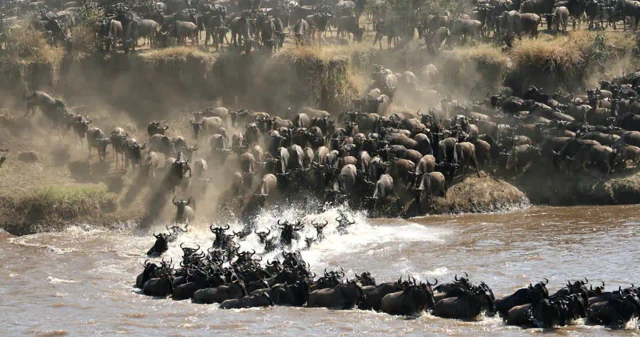
August is when Mara River crossings often reach their peak. Thousands of wildebeest gather on the bank, hesitate, then plunge in together.
Many herds move on into Kenya's Masai Mara, but Bradt Guides notes that about half stay in the northern Serengeti and cross back and forth in smaller groups. Fahamu Safaris plans crossing safaris from the Tanzanian side, around Kogatende, where you watch the same river with fewer vehicles.
September
September is still dry, and the crossings continue. The herds are spread between the northern Serengeti and the Masai Mara. There are slightly fewer visitors than in August, which makes it a favourite month for many travellers.
October
In October the first rain falls in the south, and the herds start to turn back. In our experience, crossings can carry on into October, and National Geographic reports crossings into early November in some years.
By the end of the month, long columns move through the east of the park towards Lobo, and the loop starts again.
When Is the Best Time to See the Great Migration?
There's no single best month, because the Great Migration offers something different all year. For calving, go in February. For the rut and the Grumeti crossings, go in late May or June. For Mara River crossings, go from July to September. For fewer vehicles, try November, March or early June.
Match the month to your trip:
- Newborn calves and predators: February in the southern Serengeti.
- Big herds on the move: April and May in the central Serengeti.
- The rut and the Grumeti crossings: late May and June in the Western Corridor.
- Mara River crossings: July to September, with August often the busiest.
- A quieter safari: November and March, when fewer people travel.
Whichever month you choose, the rain sets the timetable. An early or late rainy season can move the herds a few weeks either way. For the bigger picture, including the beach and Kilimanjaro, see our guide to the best time to visit Tanzania.
How Do You Plan a Safari Around the Migration?
Start with the month, then pick the part of the Serengeti where the herds should be, and give yourself enough time there. Fahamu Safaris suggests at least two nights in the south for calving season and three nights or more in the north for river crossings, because crossings take patience.
- Choose the right area. Base yourself in the south from December to March, in the centre and west from April to June, and in the north from July to October.
- Stay longer for crossings. Herds can wait on the riverbank for hours, or turn back and try again later.
- Drive or fly. Flying in saves a long drive, especially to the north. Our 11-day Serengeti and Zanzibar fly-in safari shows how it works.
- Go private. On a private safari, your guide can change the plan when the herds move.
- Add the beach. A migration safari with Zanzibar ends the trip with a few days by the sea.
July to September is high season, so it helps to know what a safari costs before you choose your dates. Mornings on the plains can be cool, and our safari packing list shows what to bring.
Conclusion: Follow the Rain, Find the Herds
The Great Migration is never in the same place for long. Keep these points in mind:
- The herds move all year: south from December to March, west from April to June and north from July to October.
- Pick your month by what you want to see: calves, the rut or the river crossings.
- Allow for the rain: timing shifts a little every year, so give yourself enough nights in the right area.
Tell our Arusha team which month you can travel, and we'll plan a route that puts you close to the herds. Karibu Serengeti!